
To trust the literary is to see through the ‘lies’, the deceptions and ‘mischievousness’ of the mainstream. Through dissent (and withdrawal), a reinvention and reinvigoration (a ‘clear urgency’).
There is a poet on the street corner and, somewhere in every city, there is a wall that has been read more carefully than any book in its libraries. ‘GOLD FOR CASH’ writes a government building, while penis enlargements are promised to lost lovers. An internet café on the corner still functions in Times New Roman, as if Microsoft Word is a civic identity. None of it carries an ISBN or colophon, but suggests the simplest definition of ‘publication’: to make something public. Beyond the book, publishing can be understood as a point on a public continuum. A kind of network wherein knowledge becomes codified through interactions with multiple imagined worlds and formulated by a kind of poetics that binds people before pages. I want to introduce a mischief into this dynamic: publishing’s reluctance of taxonomy or typology, as an object caught between space and time, as something underground or allergic to a singular container. Publishing in these terms is not a genre, or an industry, but an attitude. It is the spoken word, a performed gesture, the rumour, proclamation, song, cry, wall, pamphlet, letter, poster, or lost sheet. With or without an ISBN, it is the book, the zine, the vinyl, the CD, the tape, the webpage and words shared between friends on Hope Street reciting a text.
‘Common’ is the main conspirator here:
Community
Communication
Commons
Commute
In trying to understand publishing within the South African context, this text sits with the word ‘common’. This text is not about books (although they are implicated), nor is it about the letter press or the machines (although they are mentioned). Rather, it tries to understand the history of an attitude related to the formation of common grounds, testing grounds, and very few middle grounds. I fluctuate between the private and public realm, the city of Cape Town and South Africa more broadly, as circulation requires networks and relational markers, but also scales. I write in this manner to speak through the collapse of media into a single term. Somewhere in between these lines is a borrower’s sensibility and a punk prayer, I publish a genealogy of my own. Where narrative reaches its limits and the trail of evidence becomes too esoteric, I turn to index: names, dates, presses, rumours, closures, resurrections—where the reader and read, speaker and listener, friend and friend, comrade, conspirator, whisperer, composer and wordsmith meet.
To start,
a rumour in two parts.
Print is not dying.
Publishing won’t let it.
The first commons is unreal. In Imagined Communities, Benedict Anderson argues that nations are not discovered but composed, assembled through acts of collective imagination and materials of belonging. Before radio, cinema, or television, print capitalism dictated the formation of subcultures. Language, printed, standardised and shared, allowed strangers to not only inhabit the same time as others, but to also form collective rituals en masse. While flattening in one way, and expansive in the next, media scores othering and belonging and the rules of who counted as part of ‘the public’.
South Africa inherited this logic under profoundly unequal conditions. The first printing press arrived at the Cape in the 1790s, followed by missionary presses with crates of equal scripture and empire. Lovedale Press, established in 1823 in the small town of Alice in the Eastern Cape, and Morija Press in 1861 in present-day Lesotho, printed respectively in isiXhosa and Sesotho, creating the first infrastructures through which indigenous languages entered print publication. Yet, these presses were equally instrumentalised for the administrative logic of colonial rule—leveraging regimes of knowledge and the fixity of print to disallow an alternative community to form, whilst maintaining an iron grip on the means of production or legibility.
In 1948 the machinery tightened. African-language publishing was ‘de-linked from [its] missionary patronage and inserted within the overall designs of apartheid's ideology of ethnic nationalism.’ Through the Bantu Education system and its Language Boards, publishers like Lovedale decommissioned any thoughts of literature, poetry, praise and prose for compulsory Verwoerdian didactics and moralistic dredge. This dogma aided in maintaining fragmented minorities and world-building became alien to the individual—out of earshot of other modes of publishing—and, in new urbanism, organised exploitative labour at a distance.
From the earliest instances of print publication, attempts of subaltern in literary or artistic representation has been ‘under siege’, constrained less by a lack of authors but more so by these systems of censorship. The manuscript, the score, and the formality was policed by the Publications and Entertainment Act (1963) and impossibilities of banning, imprisonment, risk and exile meant that Black writers were systematically removed from the public sphere—made recluses for rehearsing an act of freedom and the very material of culture: generosity.
It is through these systems of malice that another kind of mischief emerges. Borrowing Stuart Hall's three reading codes—the dominant-hegemonic, the negotiated, and the oppositional—I read them not only as ways of receiving meaning but, in the South African context, as ways of publishing it.
The dominant-hegemonic code is the orderly route: the missionary press, the state publisher, the commercial house, the university press. Each of these imagine a reader already in agreement with the world it presents. Power recited, and referencing itself— a snake eating its own tail. The negotiated code loosens that certainty, making room for compromise, ambiguity, and partial dissent.
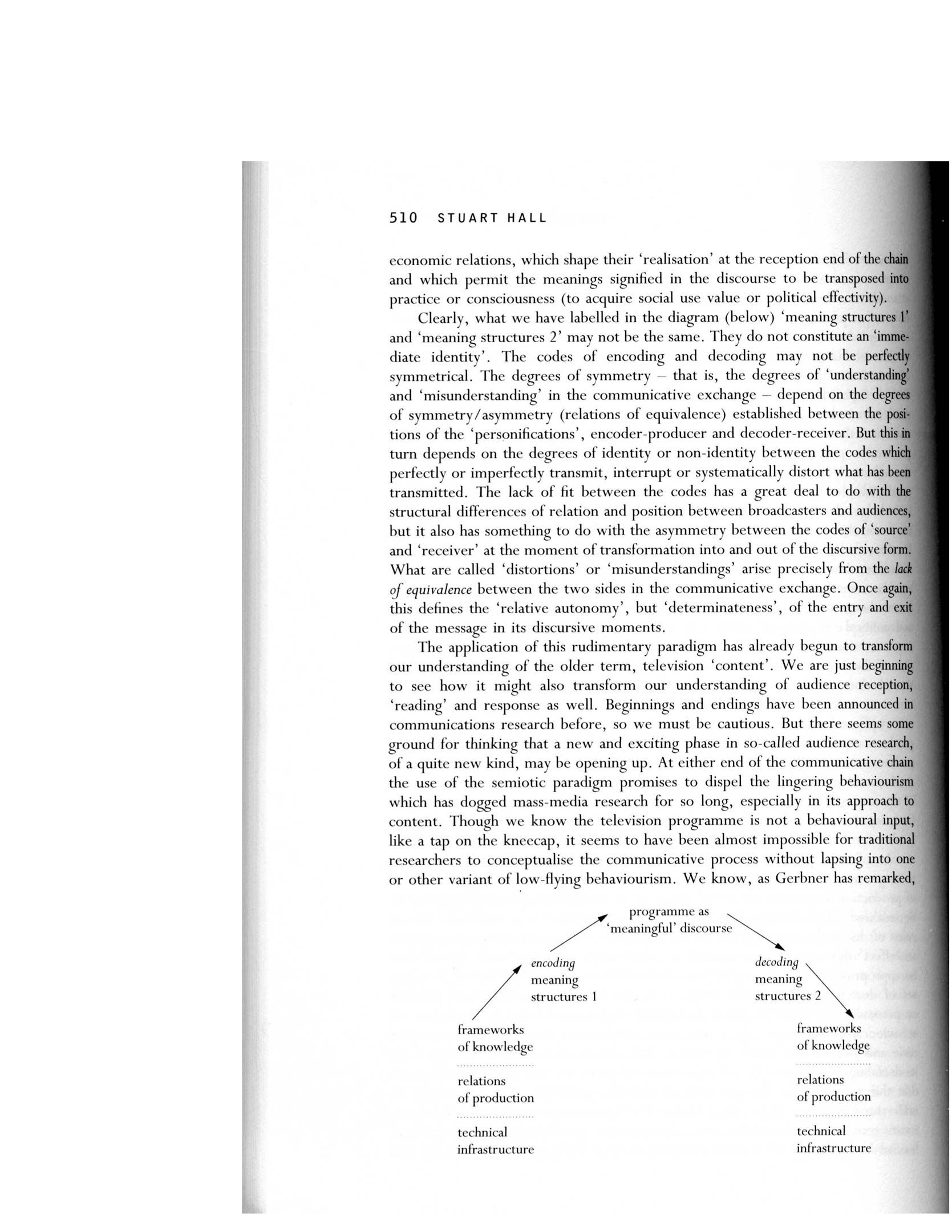
But it is the oppositional code, the vandal, that is best represented by the independent and artistic publisher. As the title suggests, here is the highest mischief: practices that refuse sanctioned readers, materials, size, form, core or cover. Writing in a minor language or composing concrete poetry. Printing on cheap paper. Moving beneath or beyond institutional routes. Xerox, Xerox! Mischief, in this sense, is editorial before it is ideological, given its insistence that ideas travel otherwise, and that other predetermined publics browse in wait.
Independent publishing has almost instinctively understood this code. Independent, as a qualifier, is not a question of ownership. While economies may be improvised, independents premise readership assembled through affinity rather than market- research. Independents are micro, sometimes pico, frequently collective, volunteered, almost always precarious, rendering it less of a business model than a vocation—an open-door policy for debate and discussion.
Read in the South Africa context, independence is a political moniker. At the height of apartheid, independent publishers broke ground through a series of journals, magazines, pamphlets, zines, books, performances, recordings and later websites as a means to communicate something else. Outside of institutions, the carried-forward impulses and urgencies of poets, artists and writers, these presses emphasised the irrational, dream-like and rage-filled expressions as legitimate information for mass circulation as well as centres to peripheral subjectivities. It’s from this nerve, the multiscalar assemblage of people, objects and place, that the majority of these publishers used ‘oppositional’ rather than ‘independent’ to describe their work and position.
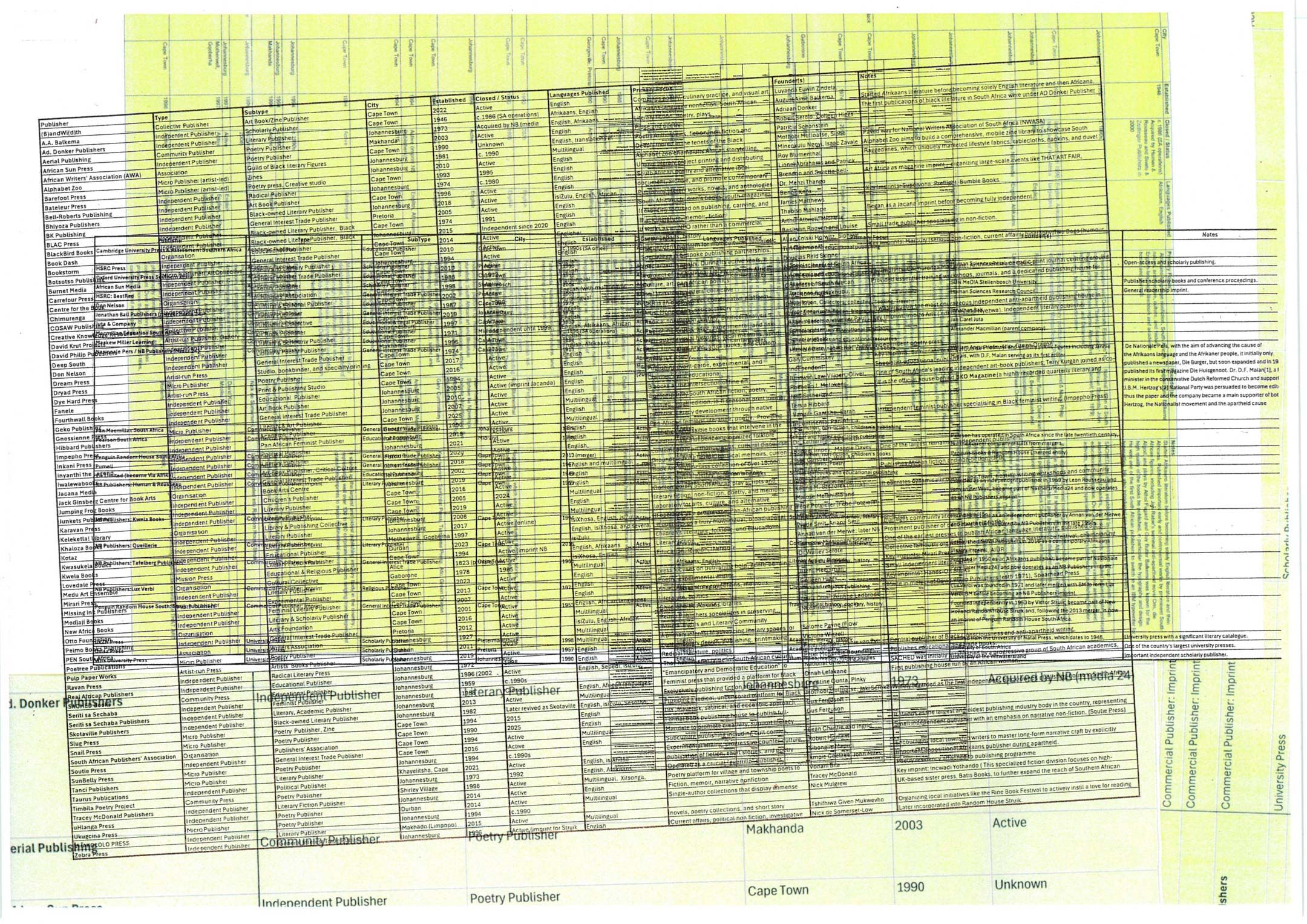
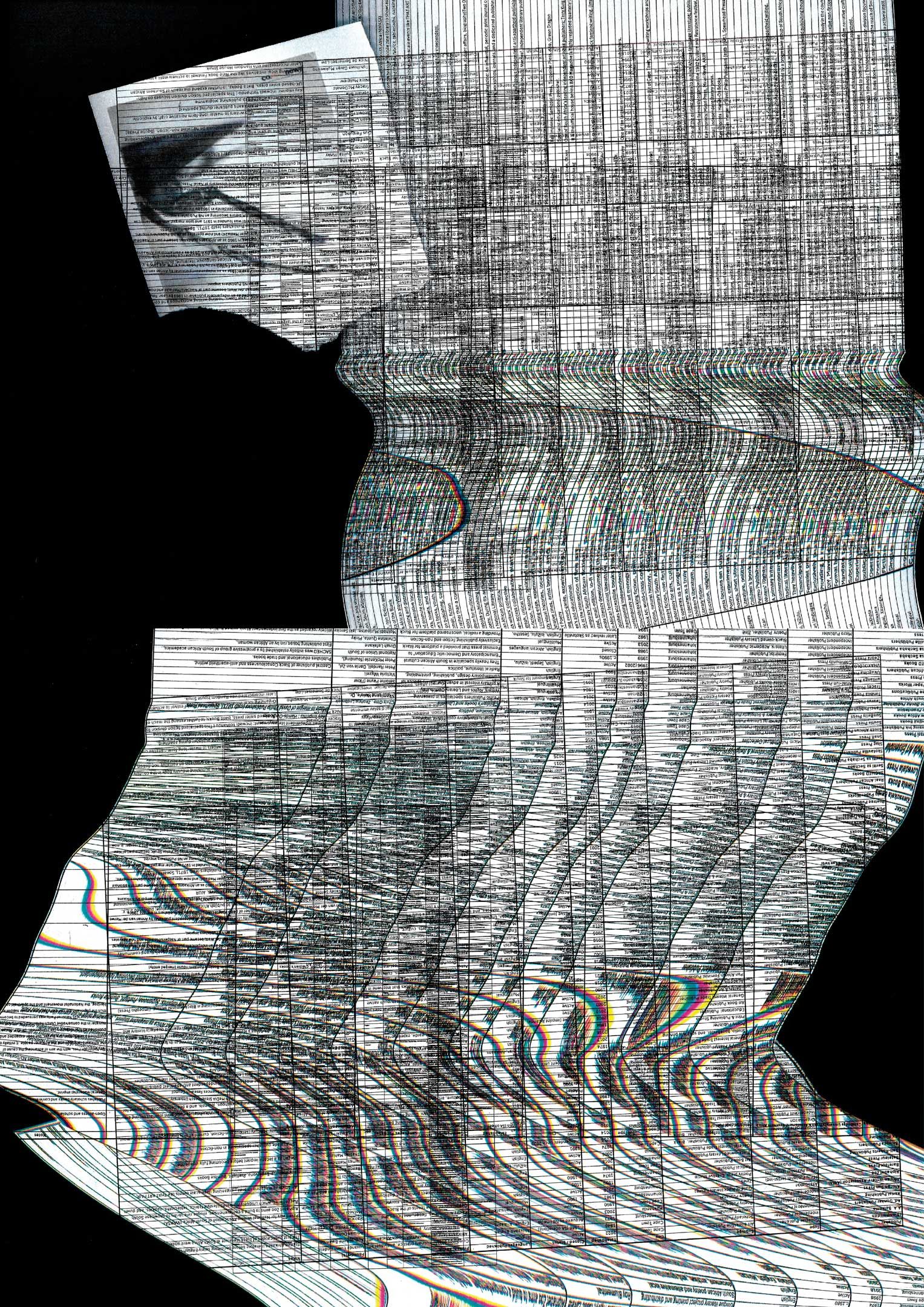
The scan that follows is a genealogy of these publishing activities on axes of time, place, and scale. It notes three publishing traditions—Black, English and Afrikaans—developing alongside one another while rarely addressing the same public, alongside annotations of loss.That loss stems partly from the ephemeral nature of the material itself, but also from legitimate desires for anonymity, obscurity, locality, and closed circuits over open ones—choices shaped by the conditions of their time.
Those conditions narrowed further in the 1960s, often cited as a ‘decade of Black silence’. While robust revolutionary publishing flourished through the civil rights and feminist movements elsewhere, apartheid was unflinching in its public domination of the media. Having arguably ‘invented’ Sophiatown, DRUM magazine’s quotidian accounts of Black urban life became one of the regime's early targets of censorship.
Over the next two decades, silence was replaced by a publishing insurgency. White liberalist Ravan Pressbecame one of its central vehicles, publishing Steve Biko's I Write What I Like in 1978 after his death in detention and establishing itself as one of the country's most significant oppositional presses. That same year Staffrider magazine appeared as an imprint of Ravan Press and later sustained through Congress of South African Writers (COSAW). Staffrider functioned less like a conventional literary magazine and more like jazz. It improvised as a polyphonic and defiantly promoted voices excluded elsewhere. Alongside it came Work in Progress, Speak,and the short-lived BLAC (Black Literature, Arts and Culture)founded by James Matthews in Athlone, and numerous smaller initiatives that in process and product allowed Black authors rehearsal of freedoms.
The most important intervention arrived with Skotaville Publishers, founded in late 1982 by Mothobi Mutloatse and Jaki Seroke. Mutloatse, a writer and journalist, had been Chairman of PEN Johannesburg and was one of the co-founders of Staffrider, while Seroke ran Babupi Reading Clubs of 1978 and 1979 and formed part of the editorial team of Ravan. Skotaville was the first publishing house to be Black-owned, Black-conceived, Black-staffed and Black-managed, with the ambition to ‘produce Black literature’ that was ‘relevant and contemporary—and to do it under Black control from start to finish’, all of their books ‘reflect Black people doing something for themselves’.Their 150 titles, by over 100 authors, speak to a gathering of intelligence and a political will of self-determination.
In the 1990s, the genealogy glitches.
Democracy did not produce a seamless public so much as what Finlay described as a myth of consensus. Rather, publishers inherited the impossible task of speaking to a newly imagined nation while structurally conserving white ownership, readership, and distribution. For many independent presses, the transition was less liberation than attrition. International donors withdrew as the apartheid cause ‘ended’; activists and intellectuals entered state institutions; large conglomerates absorbed oppositional catalogues into larger houses; and government support for independent literary publishing failed to materialise. Ravan disappeared in the mergers and acquisitions. Others simply folded.
The result was not a complete disappearance of independent publishing but the interruption of its lineage: Black-owned publishers remain a novelty rather than an inherited tradition, while continued opposition is seemingly rendered unwarranted.
The mischief, though, simply reconvened. Seriti sa Sechaba, founded in 1988 with Black women readers and writers at its centre, anticipated presses such as Modjaji Books in the 2000s. A scattered republic of magazines and performative imprints emerged—Botsotso, Timbila, Kotaz, Slug Press, Green Dragon, Bleksem and Dye Hard Press . Barefoot Press printed poems on tablecloths, while others folded A4 sheets, photocopied booklets and leaned into design logics that embraced impermanence and experience as a cue for multiple unfolding cultural centres.
On the internet and through desktop publishing, projects such as Electronic Sesame, Isibongo, LitNet, donga, Literary Gymnast and South Rain Poetry built online domains, while print publishing continued to evolve through mostly artist-led and experimental initiatives. Here, Chimurenga is perhaps the most internationally recognised of these contemporary projects. It operates simultaneously as an independent publisher, magazine, archive, exhibition, performance, radio station, and research platform for Black intellectualism across the African diaspora. It is Pan African Space Station. It is Chronic. It publishes its roll call of collaborators—carrying histories and technologies forward, tightly connected yet continually in flux.
Chimurenga overlaps with a second list sent to me by the 2026 Cape Town Print Fair on 18 May.
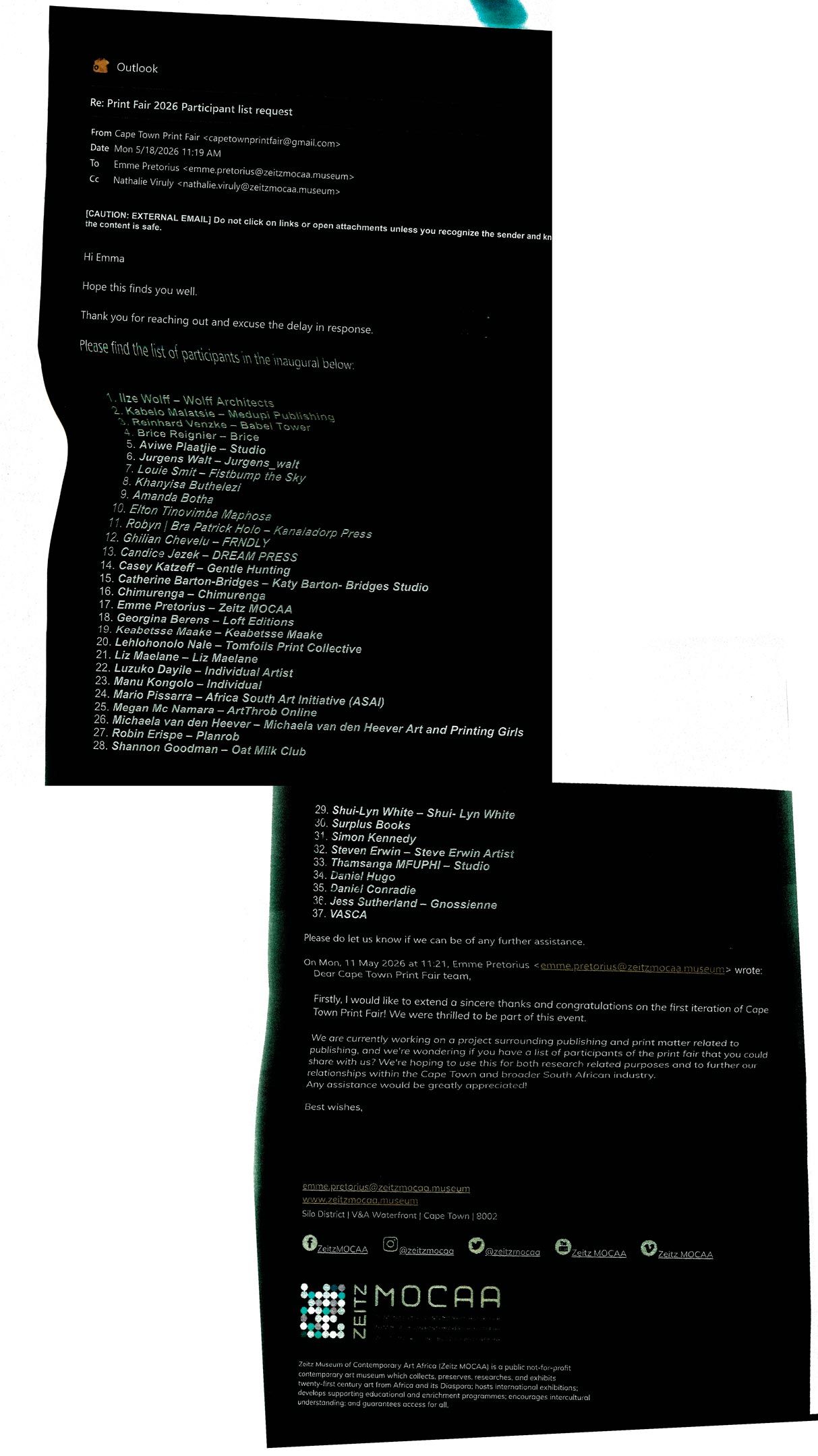
The overarching publishing industry would say that publication sales are declining, with literacy levels continuously low and barriers to production—copyright, paper costs and more—increasingly restrictive. Yet, the 37 publishers and artists listed above make those terms feel unsatisfying. With ‘oppositional’ retired, are theses gestures contrarian? I return to ‘mischievous’, or ‘unbothered’—a kind of relaxed confidence in work that might be overlooked and yet somehow still feels imperative—as publishing should, writes Lucy Lippard. Perhaps the line of devilry here lies in the artist’s well-worn vocation as an unending misfit, borne of an incurable curiosity that defies the status quo.
The inaugural Cape Town Print Fair is held in the hollowed-out former FNB building, its walls seemingly undecided about whether they are being demolished or built. It is provisional, assembled, held together by intention rather than permanence, balancing on donkey legs. Children cut and fold paper into series and signatures. It is industrious without feeling anxious. There is an otherness in the redundancy, or in the outmoded methods of making on display, that intermingles with a reader who is a part-time netizen rather than the Cape Town regular.
On the outside, I write a soft manifesto as I stand among the vendors of St George’s Mall, next to the building housing the fair, watching the crafters pack their wares to avoid the dog-ears that find wood as readily as they do paper.
And on the uses of disorder, I look to Mexican conceptual artist and communication strategist Ulises Carrión, who insists that a book is merely a ‘structure’ and ‘space-time sequence’: not an object, but a vehicle through which signs move across distance and duration.
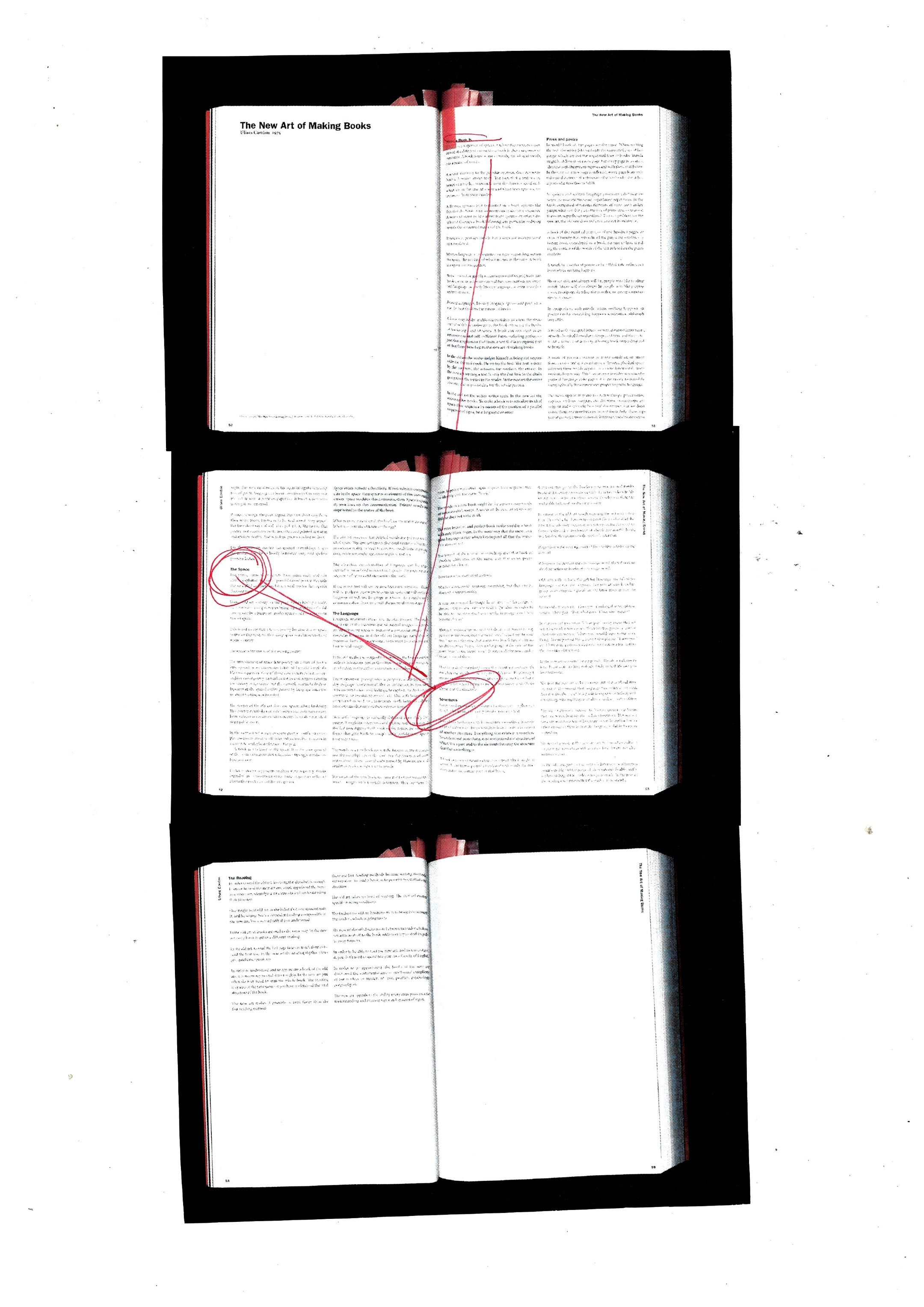
The fair and the market are structures of gathering that hold groups beyond their estrangement, along the line between private desire and public exchange. Built into this is an intimacy and exposure whereby something published belongs to those who encounter it and demand it. There are those who can demand privacy, the full scope of escape needed to read, listen and look, or the strange surrender in which not everything can be perceived all at once. Then there are those who are public, sate- and self-authored, and without reprieve.
Perhaps this flux of publics is what independent publishing here has always understood—the multitude that unsettles the idea of a nation, but also the need for something of one’s own. Perhaps this is the why of publishing in South Africa. Why publish anything at all? For accomplices? For a new culture that auto-writes itself in parts, whether institutions recognise it or not, through borrowed hands and strange proclamations of the sojourner?
I hold two books I bought but could not afford. Inside the Cape Town Print Fair, Chimurenga is in session; and outside, the dealers of asphalt loci sell flowers and photographs of you with your pedestrian lover. I stand in the poetics of commerce—the mark-up, the design of the deal and the coin. Mischief is earned only in the why nots of the willing buyer or willing seller. The reader or the read.

Process Note
Comments